
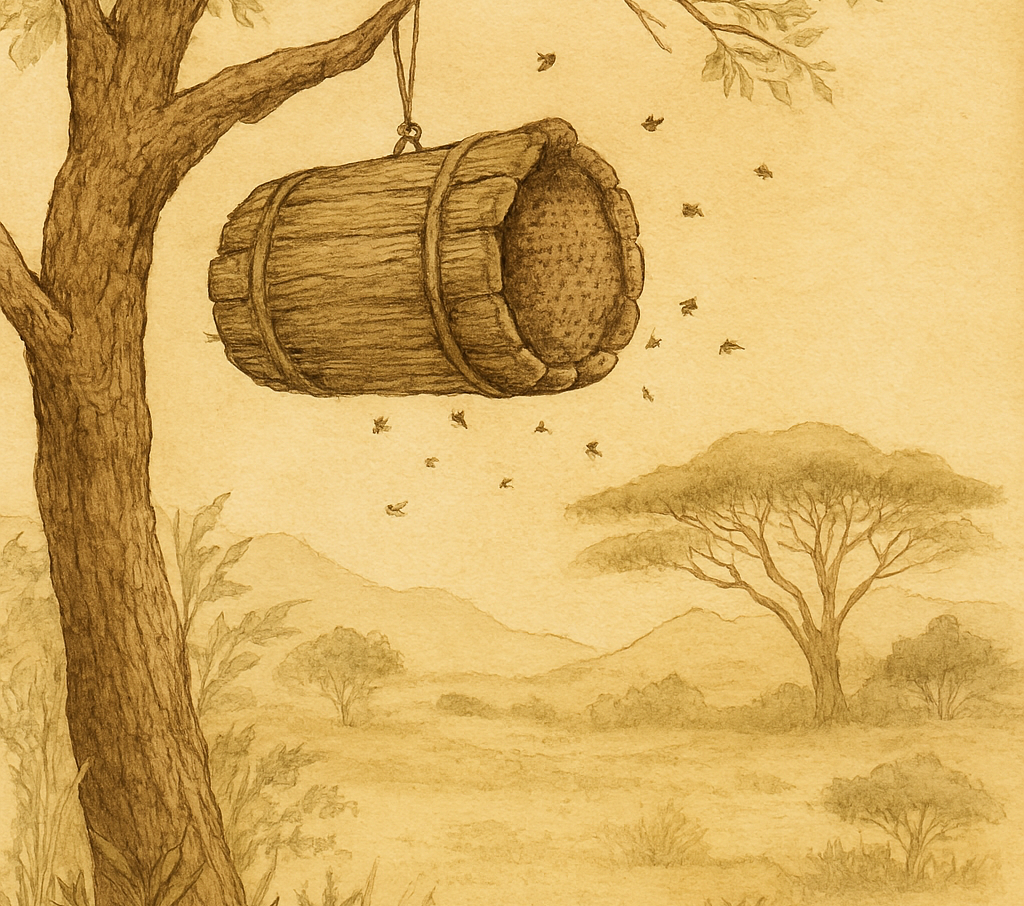
The Kikuyu community cherished the bees, believing them to be a gift from Ngai. Beekeeping was a major socioeconomic industry creating a self-sustaining ecosystem between the bees, the beekeepers, the beekeeping professionals, and the community, as documented in this post.
The Bee
The Kikuyu name for bee is njuki. The bee is also commonly referred to as “njukĩ muhunga ihua,” which can be loosely translated as “bee the investigator of the flower.”
The Agikuyu community recognized and classified bees into three types of colonies, namely hinga, ndambarari, and gĩkĩgiĩ. The categorization is based on how a colony attaches its honeycomb within the hive.
Hinga
These colonies derive their name from the word “hinga,” which means “closing,” based on its cross-sectional building design, resulting in each honeycomb eclipsing the subsequent honeycombs.
The honey harvesters narrate that it is the most violent bee, requiring them to smoke after removing each honeycomb, and hence their reference to it as “hinga” may imply “hypocrite,” which is coincidentally the synonym of “hinga.”
The ndambarari colony
These bee colonies are named after the word “ndambarari,” which can be directly translated as “longitudinal section design.” These colonies are the least violent and easy to harvest since the calming smoke can easily penetrate across the hive through the parallel honeycombs.
The gĩkĩgiĩ colony
The gĩkĩgiĩ colonies are known to attach the honeycombs diagonally within a hive. are arranged diagonally. The smoke penetrates better than in the Hinga colony, making harvesting difficulty medium. The bee is known for its spectacular and intricate pattern.
Other notable bee descriptors within the community include:
The Mysterious Messenger
The bee was also believed to be a natural messenger, with the Gikuyu community believing that a visit by a bee in your homestead, especially when the bee tries to circle you, is an indication that you will have visitors.
The One-Sting Soldier
The bee is also known for its selfless sacrifice as the one sting soldier, giving up its life to protect the hive from threats. This selfless act is perceived as a symbol of courage and loyalty within the community.
The Mythical Army
The legends of the community claims that the bees played an active role in fighting giants who were allegdelly terrorizing the existence of the agikuyu in ancient times.
The master Architect
Agikuyu community bees recognized as master architect gifted builders with a secret formula for building the two-layered sheets of hexagonal holes in honeycombs. They are also respected for their ability to seal the beehive, attach the honeycombs, and build queen cells.
The beekeepers
Bee keeping in the Kikuyu community was a men affair.
The large apiaries were mainly kept by individual men (kings and the wealthy) who hired various professionals to maintain and manage them.
It was also common to have family apiary which were kept and maintained by men from a specific household.
The hives (mwatũ)
The Agikuyu kept bees in log hives made by hollowing specific tree trunks such as mũroha and mũhũtĩ (cheap and easy to carve out). Exotic and more valuable hives were made from hardwood tree which develops natural hollow center due to old age.
Hive Making
The process of making the hives was done by professionals known as “Mwai,” who foraged the forest and searched for logs. The logs were then cut into the desired sizes, and the inside was carved out to create space for the bees.
Hive Baiting
After carving the hives, the next step was baiting the hive. This was done by professional baiters known as “Mũtero,” who used fire, mũtero, makũriũ, and propolis, among others, to make the hive more attractive to bees.
Hive Hanging
The baiting was followed by hanging the hives in strategic areas to attract swarms of bees. The hanging of the hives was done by professionals known as “Mwaniki.” The mwanikis selected the desirable trees and locations near enough to the homesteads to guard against the honey badger (thegere) and far enough to prevent bee attacks.
Bee Products
The Agikuyu were interested in four main products of the bees, namely the honey (ukĩ), bee bread and ambrosia (ngĩnda), propolis (mũhũra), and the larva (maana). The harvesting of these products was done by professional honey harvesters known as Mũthũi or Wanjũki.
The Mũthũis created smokers using certain barks, leaves, and branches of certain trees to calm the bees, allowing the harvesters to collect honey without being attacked. After extracting the products, the Mũthũis would take the products to the owner or owners of the hive for sharing.
The honey would then be shared among the community members, with certain portions set aside for ceremonial or medicinal purposes. The honey and the bee bread were mainly used for consumption, meat preservation (rũkũri), and medicine preparation. A combination of the larva and honey was used to make a traditional liquor known as mũratina, while propolis was mainly used for hive baiting.
Honey storage
Men were the custodians of honey, and it was stored in thingira (man’s house). It was stored in a hollow log known as a kĩhembe kĩa ũkĩ.
Research points
- History—Was beekeeping learnt through interaction with other tribes?
- Reservation of all bee colonies—What are the effects of modern beehives, such as Langstroth and Kenya top bar hives, whose design only favors the Hinga colonies?
Proverbs Related to Beekeeping
Kamũhũthia kaharũrũkagia mwatũ
Thegere igĩrĩ itiremagwo nĩ mwatũ
kirimũ no ta mwatũ
The article is quite educative. I am looking forward for more stories. Thank you.